Auto Heavy-Duty
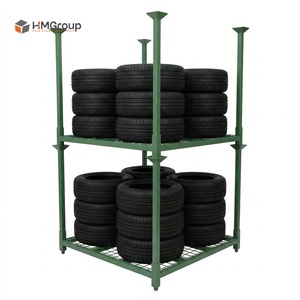
Direct factory OEM manufacturing of nested low-profile cart systems, tire storage modules, chemical-resistant finishes, and dynamic high-bay pallet racking.
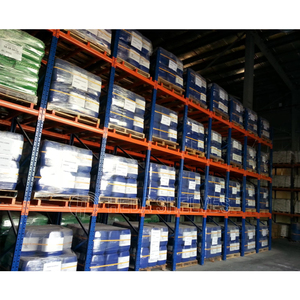
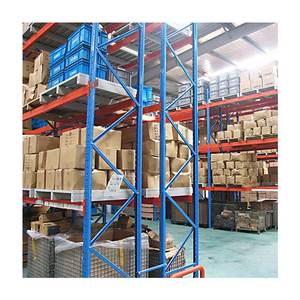
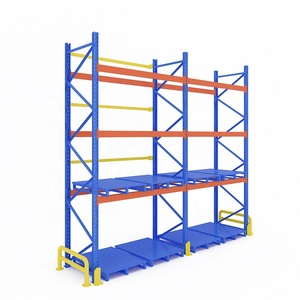
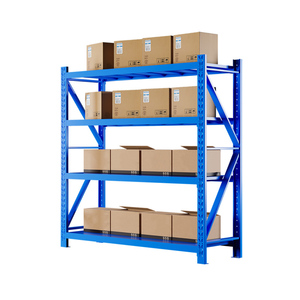
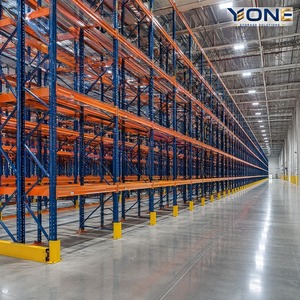
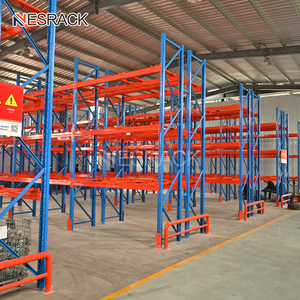
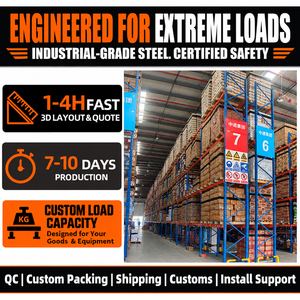
A detailed look at gravitational inclination, nested carriage telemetry, safety fail-safes, and structural metallurgy for operations engineers.
Push back racking systems represent the ultimate balance between high-density compact footprint and selective accessibility. Engineered around a Last-In, First-Out (LIFO) pallet rotation flow, push back racks utilize a series of nested rolling carts that ride on inclined structural steel channels. When an initial pallet is loaded onto the topmost cart, subsequent pallet entries gently push that unit backward, exposing the underlying carriage. During retrieval, gravity gradually propels nested pallets forward to the pick face at an ergonomically damped velocity, eliminating forklift penetration into racking lanes.
Unlike standard drive-in racking that exposes upright frames to continuous forklift collisions, push back systems isolate all vehicle interaction to the aisle-facing pick apron. The structural longevity of a push-back rack depends heavily on the carriage bearing assembly and rail geometry. Our manufacturing facility employs high-tensile, case-hardened steel wheel bearings sealed against fine particulate ingress and rated for harsh cold-chain operations down to -30°C (-22°F). Low-profile nested cart designs optimize vertical lift bay clearance, allowing facilities to compress 2, 3, 4, 5, or 6 deep pallet lanes within vertical spaces typically restricted to selective rack profiles.
| Parametric Attribute | Standard Industrial Spec | Heavy-Duty Industrial Spec | Custom OEM Cold-Storage Spec |
|---|---|---|---|
| Pallet Depth Configuration | 2-Deep to 3-Deep Nested | 4-Deep to 5-Deep Heavy Cart | 2-Deep to 6-Deep Low-Profile |
| Unit Load Capacity (Per Pallet) | 1,000 kg (2,200 lbs) | 1,500 kg (3,300 lbs) | 2,000+ kg (Custom Engineering) |
| Track Gravity Slope Gradient | 2.5% to 3.0% Incline | 2.0% to 2.8% Damped Incline | Calibrated Gradient (-30°C Verified) |
| Bearing & Wheel Architecture | Shielded Flanged Bearings | Precision Machined Steel Wheel | Stainless Encapsulated Low-Temp Grease |
| Structural Steel Metallurgy | Q235B Cold-Formed Steel | Q355B / ASTM A572 Grade 50 | Structural Tubular Heavy Welded Channels |
| Corrosion Protection Treatment | Electrostatic Epoxy Powder Coat | High-Impact Hybrid Polyester | Hot-Dip Galvanized (ISO 1461 Compliant) |
A critical engineering consideration in multi-deep push-back cart configurations is preventing kinematic binding when returning carriages descend to the pick position. Our push-back rail rails utilize multi-radius stamped safety stops, acoustic damping strips, and cart-capture interlocks that prevent derailed carriages even under unaligned pallet placement. Coupled with heavy-duty structural column bullnoses and reinforced wrap-around base guards, our systems absorb accidental forklift impacts without deflecting primary load columns.
From complete layout calculations to ISO-certified CNC roll forming and robotic welding lines, discover the manufacturing precision behind our storage frames.
We manufacture any length, bay width, height, and depth combination required by non-standard European, North American GMA, or Asian pallet specifications. No rigid catalog constraints.
Equipped with computerized high-precision roll-forming lines, robotic CNC beam welders, and automated multi-stage powder coat pretreatment, achieving 100% structural repeatability.
Validate your warehouse storage metrics before material deployment. We supply precise 2D warehouse elevation schematics and complete 3D BIM/Revit spatial calculations free of charge.
From metallurgical verification and space planning to containerized export packing and site installation oversight, we take ownership of delivering high-performance operational units.
Patented cart linking pins, anti-tip rear anchors, and captive channel wheels prevent carts from dislodging or tilting upwards during erratic forklift loading sequences.
Structural assemblies undergo finite element stress analysis (FEA) and physical cycle testing against ANSI MH16.1, EN 15512, and AS4084 building and racking codes.
How automated guided vehicles (AGVs), cold-chain expansion, and predictive rack telematics are reshaping push-back procurement over the next decade.
In modern high-velocity distribution centers, real estate lease rates and energy costs for climate-controlled facilities have escalated dramatically. Facility directors are turning away from low-density selective racking toward nested push-back designs that reclaim up to 55% of floor space by compressing aisle configurations. As procurement teams evaluate capital infrastructure over a 15-to-20-year horizon, several technological and design advancements are fundamentally altering system specifications.
Modern push-back systems increasingly incorporate laser target apertures and high-contrast alignment decals engineered specifically for automated guided reach trucks and vision-guided forklift sensors.
With massive growth in frozen food logistics, procurement focuses on Charpy V-notch impact-tested structural steel that retains high ductility at temperatures below -30°C without risk of brittle fracturing.
New multi-carriage nesting geometries shave off up to 75mm of lost vertical clearance per bay, enabling an additional storage level within standard 10-meter warehouse clear-height envelopes.
Combining front push-back lanes with rear gravity roller lanes allows facilities to transition dynamically between LIFO buffer storage and FIFO fulfillment lanes within identical frame structural modules.
Procurement teams are prioritizing pre-assembled cart cassettes with pre-torqued wheels that slide into standard structural teardrop or slotted upright beams, dramatically cutting field installation hours.
Zero-VOC, heavy-metal-free electrostatic powder coating finishes reduce the cradle-to-gate carbon footprint of warehouse racking systems, aiding corporate LEED v4 and net-zero building certifications.
Answers to essential technical, logistical, and structural questions raised by project developers, supply chain engineers, and procurement leads.