Technical Whitepaper & Structural Directives
Engineering Static Pallet Racking in Guadalajara: Seismic Compliance, Metallurgy, and Warehouse Volumetric Optimization
As the primary logistics crossroads and manufacturing epicenter of Western Mexico, the Guadalajara Metropolitan Area—encompassing major industrial corridors in El Salto, Tlajomulco, Zapopan, and Periférico Sur—presents a unique set of structural and regulatory challenges for industrial storage systems. Designing static pallet racking here demands rigorous engineering that balances high-density SKU accessibility against complex dynamic seismic forces, rigorous slab-loading constraints, and the shifting needs of multinational supply chains operating under USMCA nearshoring frameworks.
Crucial Structural Engineering Factor: Under the Manual de Diseño de Obras Civiles (CFE-MDOC) and the Jalisco State Building Regulations, Guadalajara falls within Seismic Zone 3 (Zona Sísmica III). All static pallet racks exceeding 3.0 meters in top-beam height must incorporate certified moment-resisting beam-to-column connections, baseplates dimensioned for dynamic shear dissipation, and anchor bolt pull-out calculations verified against local concrete slab compression thresholds.
1. Seismic Zone Structural Mechanics: Preventing Progressive Collapse
In conventional warehouse environments, static selective pallet racks primarily carry vertical gravitational dead loads ($D$) and product live loads ($L$). However, within Jalisco's tectonic framework—influenced by the subduction of the Rivera and Cocos plates along the Middle America Trench—racking structures operate as unbraced steel moment frames in the down-aisle direction and braced vertical trusses in the cross-aisle direction.
Dynamic seismic acceleration imparts intense lateral inertial forces ($E$). When an earthquake strikes, horizontal ground motion induces cyclic shear stresses at the baseplate anchor anchors, torsion through the upright columns, and extreme rotational moments across the beam-end connectors. If beam connectors fail to resist rotational displacement or if column profiles yield due to torsional-flexural buckling, the rack structure suffers progressive multi-bay collapse.
| Structural Parameter |
Standard Static Warehouse Racks |
Guadalajara Seismic Zone 3 Engineered Racks |
Design Standard Reference |
| Steel Specification |
Commercial Grade Q235B / ASTM A36 |
High-Yield Structural Q355B / ASTM A1011 HSLAS |
EN 10025 / ASTM A1011 |
| Baseplate Dimensions |
100 mm × 120 mm × 4.0 mm |
160 mm × 180 mm × 8.0 mm to 12.0 mm (Extended Footprint) |
RMI MH16.1 Section 8.4 |
| Anchor Anchor Count |
1 × M10 or M12 Mechanical Anchor |
2 × M12 or M16 High-Tensile Wedge Anchors per Foot |
ACI 318 Appendix D / NTC-RCDF |
| Connector Locking Pins |
Standard Spring Clip (6 mm) |
Shear-Resistant High-Yield Grade 8.8 Locking Pins |
FEM 10.2.02 / ANSI MH16.1 |
| Beam Deflection Limit |
$L/180$ under Maximum Working Load |
Strict $L/200$ to $L/250$ to Prevent Dynamic P-Delta Drift |
NOM-006-STPS-2014 & RMI |
2. Cold-Formed Steel Metallurgy & Roll-Forming Tolerances
Our Guadalajara factory-direct static racking frames utilize high-strength, continuous cold-rolled carbon steel coils. By maintaining tight yield-stress controls ($f_y \ge 355\text{ MPa}$), our upright profiles provide enhanced tensile ductility without brittle fracture vulnerabilities under high-cycle vibrational frequencies. Upright columns feature an advanced multi-flange, 11-bend geometry that significantly elevates the member's polar moment of inertia ($I_z$) and torsional warping constant ($C_w$). This geometry resists lateral-torsional buckling even under maximum volumetric loading scenarios where pallets are stacked 6 to 9 tiers high.
Horizontal load beams are fabricated using continuous twin-C welded box profiles or step-beam geometries. Automatic dual-torch submerged arc welding fuses the C-channels into a monolithic, torsionally stiff closed section that uniformly distributes localized pallet runner pressure directly into the connector lugs, eliminating beam web deformation.
3. Warehouse Volumetric Density: Selective vs. High-Density Push-Back & Shuttle
With industrial land prices in Guadalajara's El Salto and Zapopan corridors surging over recent quarters due to nearshoring demand, expanding a building's physical footprint is frequently cost-prohibitive. Facilities must exploit vertical clear heights (typically between 9.5 and 14 meters in modern Class-A logistics facilities) through volumetric static racking layout strategies:
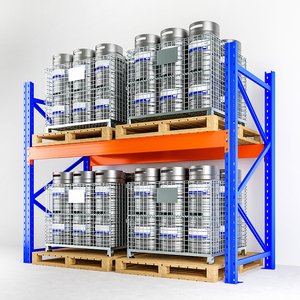
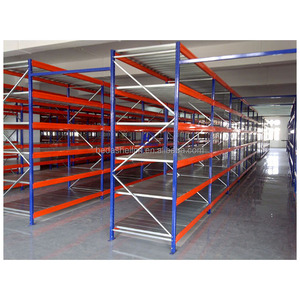
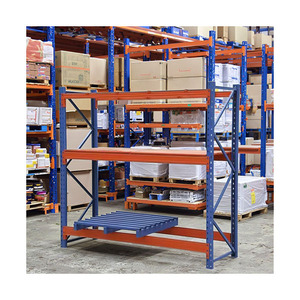
Selective Pallet Racking (100% SKU Access): Remains the benchmark for fast-moving retail distribution and electronic assembly staging where immediate access to every pallet position is mandatory. Configured with aisle widths of 3.2m to 3.8m for standard counterbalance forklifts, or condensed to 1.7m to 1.9m in Very Narrow Aisle (VNA) layouts with turret trucks, selective racking achieves 90-95% operational pallet utilization.
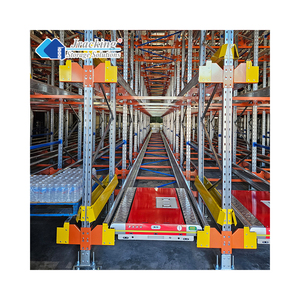
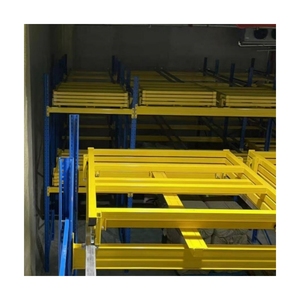
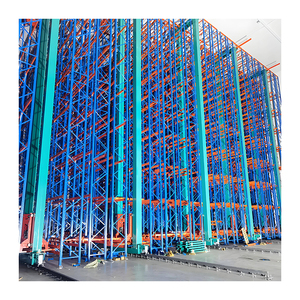
Push-Back and Pallet Shuttle Systems (LIFO/FIFO Deep Storage): In temperature-controlled cold storage facilities and tequila barrel storage cellars where floor space carries heavy environmental overhead, dynamic push-back carts or automated radio shuttles eliminate multiple operating aisles. A 4-deep push-back system boosts physical storage density by up to 75% compared to standard wide-aisle selective racking while preserving gravity-assisted front-face pallet presentation.