Engineered Storage Solutions
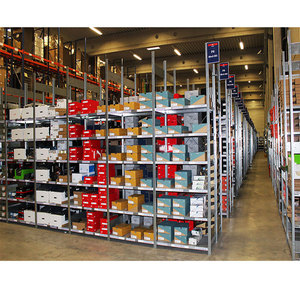
Heavy-Duty Industrial Cantilever Racking Series
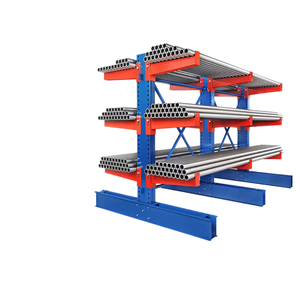
Explore our top-tier cantilever and long-goods warehouse storage systems. Designed specifically for bulky raw materials, structural steel, aluminum extrusions, timber boards, and cylindrical bar profiles.
Enterprise Strengths
Why Global Supply Chains Trust Our Cantilever Racking
From structural finite element analysis to robotic welding lines, our engineering ecosystem ensures zero deflection failures, unmatched safety, and end-to-end quality control.
Structural High-Grade Steel (Q235B / Q355B / S355JR)
We source certified hot-rolled and cold-formed structural steels from premier mills. Heavy-duty I-beams (IPE profiles) ensure severe-duty load-bearing performance without permanent strain under rated maximum capacity.
Full Robotic Welding & Precision Tolerances
Every column-to-base and arm-locking bracket is produced using multi-axis robotic welding cells. Flange alignment and hole punching maintain a precise ±0.5mm tolerance, delivering effortless job-site assembly.
Global Engineering Compliance (FEM, RMI, AS4084)
Designed and analyzed under the strictest static and seismic building criteria. Our systems consistently adhere to European FEM 10.2.02, American ANSI MH16.1 (RMI), and Australian AS4084-2012 regulatory certifications.
Automated Surface Pretreatment & Powder Coating
Our 12-stage pre-treatment, shot-blasting (Sa 2.5), and electrostatic epoxy-polyester thermo-hardened powder finishing offer high wear, corrosion, and scratch resistance, suitable for humid indoor setups and cold storage warehouses.
Complimentary 2D/3D CAD & FEA Layout Analysis
We provide full structural engineering consultation prior to manufacturing. Clients receive detailed structural deflection models, 3D dynamic simulations, and custom aisle clearance planning completely free of charge.
Turnkey OEM/ODM Global Direct Supply
Eliminate wholesale intermediaries. Benefit from direct mill-to-door bulk volume pricing, robust sea-freight bundling, container packing optimization, and comprehensive bilingual installation instructions.
Engineering Whitepaper: Structural Mechanics & Industrial Selection of Cantilever Systems
Cantilever racking constitutes the premier category of unobstructed horizontal storage for handling items characterized by irregular dimensions, non-standard lengths, and high weight densities. Unlike traditional selective pallet racking, cantilever structures eliminate front upright columns. This design architecture creates an uninterrupted picking face, radically cutting down forklift cycle maneuvering times while safeguarding high-value stock from column impact damage.
1. Structural Anatomy & Load Distribution Principles
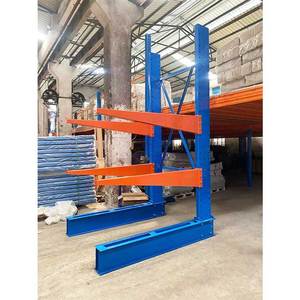
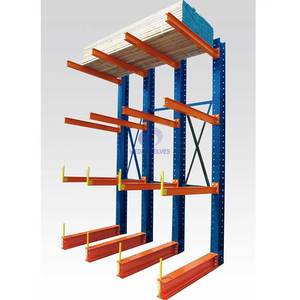
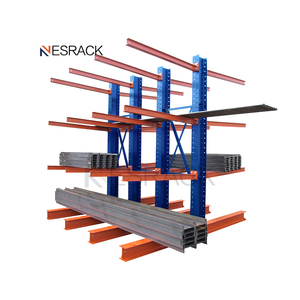
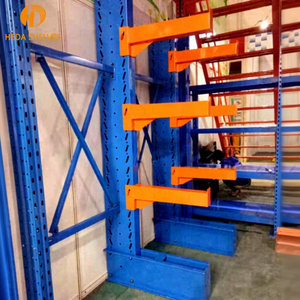
A certified industrial cantilever rack comprises four core structural components: the vertical column (upright), the heavy structural horizontal base, cantilever projecting load arms, and diagonal cross-bracing frameworks.
- Structural Hot-Rolled (IPE / H-Beam) vs. Roll-Formed Profiles: For extreme storage environments (e.g., steel service centers, lumber distribution, pipe yards), hot-rolled H-beams represent the gold standard. Roll-formed sections are economical for lighter building materials (under 600 kg per arm), whereas structural steel beams handle up to 2,500+ kg uniformly distributed load (UDL) per single arm.
- Arm Attachment Kinematics: Premium arms utilize an articulated pin or wedge-connection mechanism. Under accidental vertical forklift impacts from beneath, the articulated arm pivots upward instead of buckling, preserving the column structural core and preventing catastrophic collapse.
- Deflection Ratios & Calculations: Engineered tolerances dictate an arm deflection under maximum static load not exceeding L/250 to L/300, avoiding load run-off risks. Upright column out-of-plumb margins must be securely locked within 1/1000 deflection parameters under combined axial compression and bending moments.
2. Single-Sided vs. Double-Sided System Configurations
Warehouse space layout demands systematic balancing between aisle clearance, forklift turning radius, and floor slab anchoring strength:
- Single-Sided Configurations: Engineered to anchor adjacent to load-bearing walls or warehouse perimeters. Must be computed taking into account one-directional bending moment torque transferred to the floor anchor bolts, requiring substantial slab thickness and verified concrete pull-out capacity.
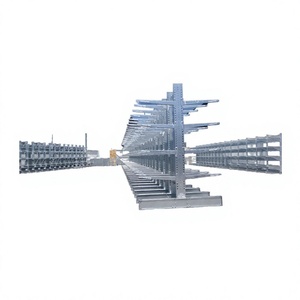
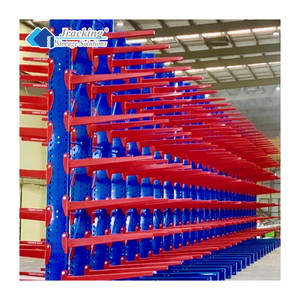
- Double-Sided Central Aisle Units: The most structurally balanced format. Opposing load arms counterbalance gravitational forces along a single spine column, greatly reducing localized shear stresses in the floor anchorage. This setup maximizes vertical space utilization in central high-density picking aisles.
3. Strategic Procurement Trends: 2026–2030 Technology Forecast
The global intralogistics landscape is experiencing a paradigm shift driven by high-density automation, land costs, and decarbonization mandates. B2B buyers must account for the following emerging procurement trends:
Mobile Autonomous Cantilevers
Mounting heavy-duty cantilever columns onto guided electric-drive floor carriages to condense aisles into a single floating access corridor, recovering up to 80% of unused aisle volume in cold-storage and timber plants.
Automated AS/RS Long-Goods Cranes
Transitioning from traditional 4-directional combi-forklifts to fully automated stacker crane systems (AS/RS) capable of accessing cantilever racks up to 30 meters high without human operational risks.
IoT Strain & Deflection Monitoring
Embedding wireless piezo-resistive strain gauges into cantilever arm connections to transmit real-time deflection and impact data, warning warehouse teams of overloading conditions before material yield limits are exceeded.
4. Total Cost of Ownership (TCO) vs. Initial Acquisition Cost
Smart procurement prioritizes life-cycle value. Sub-standard, thin-gauge cantilever systems often exhibit sagging arms within 18 months, requiring premature facility shutdowns and costly re-fabrication. Structural I-beam systems coated with specialized thermosetting powders offer operational service lifespans spanning over 25 years with negligible maintenance, delivering lower total cost per metric ton of stored cargo over time.
Procurement Knowledge Base
Frequently Asked Questions by Industrial Buyers
Answers to common structural, engineering, and logistical questions encountered when evaluating heavy-duty cantilever racking investments.
How do I determine whether my application requires hot-rolled structural steel or roll-formed cantilever racks?
The selection hinges on load weight, handling equipment, and the risk of vehicle impact. Roll-formed racks are cold-coiled from sheet gauge metal and are cost-efficient for light-to-medium loads (up to 500-700 kg per arm), such as light plastic pipes, vinyl siding, or compact moldings. Structural hot-rolled steel (IPE or HEA European standard beams, or ASTM A36/A572 I-beams) is essential for harsh environments like steel mills, raw timber yards, and outdoor storage where point loads exceed 1,000 to 2,500 kg per arm and heavy sideloader forklifts operate routinely.
What parameters are required to calculate structural capacity and receive an accurate 3D engineering proposal?
Our engineering team requires five core metrics: (1) Unit load characteristics (length, depth, height, bundle rigidity, and gross weight); (2) Target storage heights and clear building ceiling clearance; (3) Type of material handling equipment (e.g., standard counterbalanced forklift, reach truck, 4-way multi-directional truck, or side-loader); (4) Floor slab construction (concrete depth, compressive strength f'c, and rebar reinforcement); and (5) Ambient operating conditions (indoor temperature-controlled, hot-dip galvanized outdoor yard, or seismic zone rating).
Can cantilever systems safely store non-rigid, flexible, or packaged palletized materials?
Yes. By integrating continuous steel wire mesh decking, heavy steel drop-in pan decks, or timber decking spans across the cantilever arms, a flexible support surface is created. This allows hybrid operations where long materials (steel bars, pipes) and standard 1200x1000mm or 40x48-inch wooden pallets can be combined within the same aisle framework without the risk of load sag or tipping.
What surface finishes are recommended for outdoor yard cantilever installations?
For open-air outdoor yards, hot-dip galvanization conforming to ISO 1461 or ASTM A123 is standard. The entire welded column, base, and arm structure is dipped into molten zinc (450°C), generating a metallurgical alloy barrier coating with a thickness of 70 to 100 microns. This ensures complete rust-free performance across 25+ years in rain, snow, UV rays, and coastal saline atmospheres. For sheltered setups, our standard multi-phase electrostatic polyester coating provides excellent long-term durability.
What international safety compliance criteria and load test proofs do you provide?
Each installation is engineered to FEM 10.2.02 (Design of Cantilever Racking), RMI ANSI MH16.1, and AS4084 guidelines. We supply Mill Test Certificates (MTC EN 10204 Type 3.1) for steel chemical-mechanical validation, finite element structural deflection stress calculations, third-party weld ultrasonic inspection testing, and stamped structural load placards declaring official working load limits (WLL) for every storage level.