Industrial-Grade Beam Pallet Racking Solutions
Explore our flagship heavy-duty beam racking architectures, rigorously certified to FEM, RMI, and AS4084 standards. Engineered with high-yield Q235B and Q355B structural steel for maximum spatial volumetric efficiency.
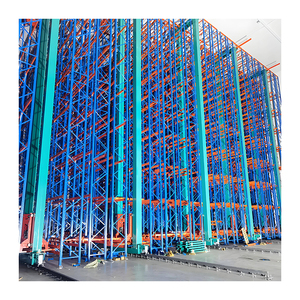
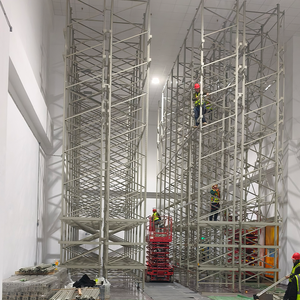
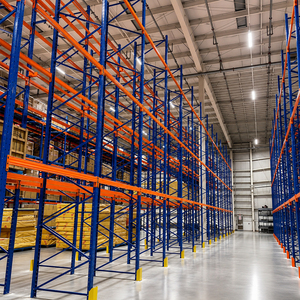
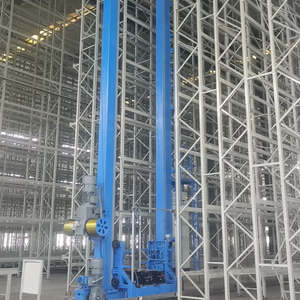
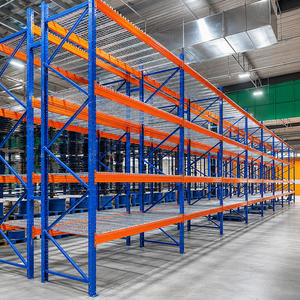
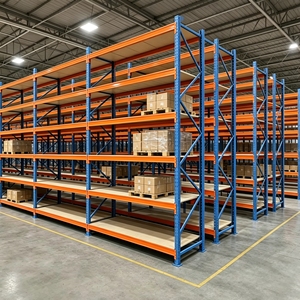
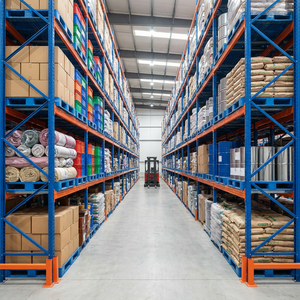
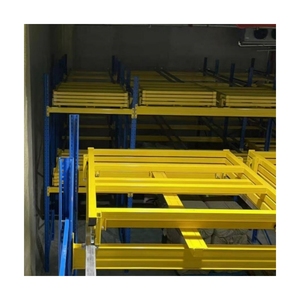
Engineering Integrity: Cold-Rolled Interlocking Box Beams & Uprights
As modern distribution nodes face surging land valuation costs and velocity demands, the structural integrity of industrial beam pallet racking constitutes the operational baseline of enterprise supply chains. Beam pallet racking (frequently specified as selective rack or teardrop/hex-slot adjustable racking) provides universal 100% accessibility to every pallet location while handling static unit loads reaching up to 3,000 kg per beam level and over 15,000 kg per upright frame bay.
At our automated manufacturing facility, structural columns are fabricated from single-strip continuous cold-rolled Q235B or high-tensile Q355B carbon steel, cold-formed into specialized 80mm to 120mm omega-profile upright sections. By integrating continuous multi-bend roll forming lines with computerized punch indexing at 50mm, 75mm, or 76.2mm pitch increments, our structural posts optimize the moment of inertia ($I_x$ and $I_y$) against axial buckling, seismic torsional shear, and dynamic forklift impact loads.
The primary load-transfer interface relies on custom-welded interlocking box beams (composed of twin C-sections internally seam-welded or continuous interlocked steel tubes) combined with high-grade 3-claw, 4-claw, or 5-claw stamped connector clips. Each beam-end connector incorporates automated spring safety locks that automatically lock under beam insertion, completely preventing beam dislodgement caused by forklift mast over-travel or rough operator extraction.
| Structural Parameter | Standard Selective Beam Racking | High-Density Pallet Shuttle Racks | Heavy-Duty Push-Back Racks |
|---|---|---|---|
| Direct Pallet Selectivity | 100% Immediate Direct Access | Lane-Dependent (FIFO or LIFO) | LIFO (2 to 6 Pallets Deep) |
| Aisle Clearance Required | 3.0m - 3.8m (Standard Counterbalance) | Single Access Point / Automated Aisle | 2.8m - 3.2m (Reach Truck Capable) |
| Volumetric Space Utilization | 40% - 50% Storage Footprint | 80% - 85% Maximum Footprint Density | 65% - 75% High Space Utilization |
| Beam Deflection Threshold | 1/200th of Span Length (FEM Standard) | 1/250th of Span Length (High Tolerance) | 1/200th of Span Length (Gravity Gradient) |
| Primary Application Profile | High SKU Variance / General FMCG | Cold Storage / Batch Manufacturing | Buffer Storage / Medium Velocity |
Surface treatments utilize an eight-stage automated chemical phosphating and nano-ceramic conversion pre-wash, followed by electrostatic thermosetting polyester powder coating baked at 200°C. This creates an abrasion-resistant, pinhole-free finish (average 60–80 microns thickness) compliant with ASTM B117 salt spray standards, making our racking ideal for ambient warehouses, humid coastal logistics hubs, and sub-zero cold-storage freezer facilities (-30°C).
Future Procurement Trends: Where Warehouse Infrastructure is Heading
Industrial logistics infrastructure is transitioning from static manual steel shelving toward integrated, intelligent structural nodes. B2B procurement directors, engineering heads, and wholesale supply chain planners must account for these dominant structural and market trends:
1. Structural Integration with Robotic Material Handling (AMRs and Pallet Shuttles): Traditional selective beam racking is increasingly deployed in conjunction with radio shuttle buggies and Automated Guided Vehicles (AGVs). This eliminates standard forklift travel within the storage lanes, enabling racks to reach vertical elevations exceeding 24 meters while maintaining sub-millimeter tolerances on beam deflections.
2. Seismic Resilience and Full Finite Element Analysis (FEA) Verification: International logistics projects now demand rigorous seismic modeling under IBC, Eurocode 3 (EN 1993-1-3), and AS4084 guidelines. Racking is no longer procured as generic hardware; engineers demand rigorous node-stiffness testing of the upright-to-beam connectors, baseplate anchor pull-out validation, and cyclic load testing curves.
3. Lifecycle Decarbonization and Modular Circularity: With ESG reporting becoming mandatory across European, American, and Asian enterprises, wholesale buyers require EPD (Environmental Product Declaration) certificates. Racks must feature modular interlocking components that can be disassembled, extended, re-slotted, or recycled with minimal embodied carbon waste.
World-Class Steel Fabrication & Direct Wholesale Supply
Direct from our state-of-the-art rolling mills and robotic welding lines to your logistics facility. We eliminate middlemen markups while delivering certified structural steel solutions backed by comprehensive engineering analysis.
Certified Raw Steel (Q235B & Q355B)
All coils are sourced directly from premier steel mills with 3.1 chemical and tensile mill test certificates, guaranteeing high yield strength and extreme impact resistance.
24-Hour CAD & 3D Engineering Layouts
Our licensed structural engineers deliver detailed AutoCAD spatial configurations, beam deflection load profiles, and 3D warehouse isometric models within 24 hours.
Robotic Seam Welding & Automated Punching
Continuous CNC roll-forming coupled with 6-axis robotic welding jigs guarantees zero weld spatter, deep penetration joins, and precise connector-to-beam alignment.
Global Code Compliance (FEM, RMI, AS4084)
Fabrication tolerances and finite element models strictly align with European FEM 10.2.02, American RMI ANSI MH16.1, and Australian AS4084 building regulations.
Heavy Duty Protective Armor Accessories
Turnkey supply includes heavy-duty floor-mounted upright column protectors, wrap-around post guards, aisle end crash barriers, drop-in pallet support bars, and wire decking.
Direct Container Packaging & Worldwide Export
Bundled with steel strapping, scratch-resistant protective film, and timber dunnage blocks tailored for sea-freight container loading, ensuring zero in-transit distortion.
Frequently Asked Questions on Pallet Racking Procurement
Critical structural, safety, and logistical details reviewed by engineers and procurement officers before signing off on warehouse racking infrastructure.
How do I calculate the required beam profile and thickness for heavy pallet loads?
What is the primary difference between teardrop punching and European hex-slot uprights?
Can your selective beam pallet racking be customized for seismic zones?
What surface coating is most appropriate for cold storage and freezer applications?
What details are required to receive a complete 24h engineering design and quote?
Ready to Maximize Warehouse Storage Capacity?
Connect directly with our engineering team for free 24-hour CAD spatial layouts, load deflection calculations, and factory-direct wholesale pricing with global container shipping.
Send an Inquiry