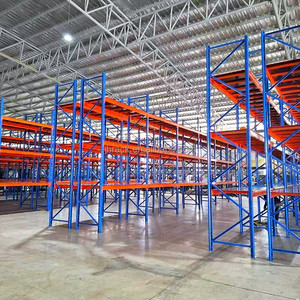
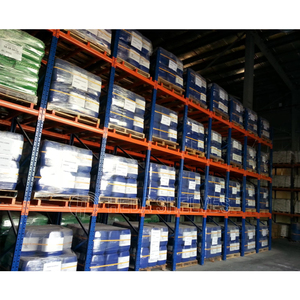
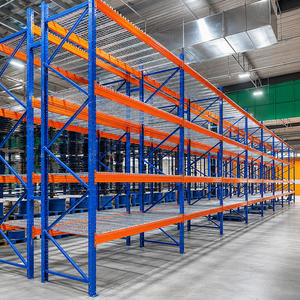
Custom-engineered racking platforms fabricated from cold-rolled structural steel (Q235B / Q355B), engineered for high-bay fulfillment centers, cold storage, and heavy-load manufacturing hubs.
Combining heavy structural steel roll-forming with precision robotics, our manufacturing base fulfills custom warehouse rack contracts for Fortune 500 third-party logistics (3PL) providers and global distributor chains.
We source prime, mill-certified hot and cold-rolled steel coils exclusively from tier-one steel complexes. Every batch of Q235B and high-yield Q355B steel undergoes ultrasonic flaw inspection, yield strength tension tests, and chemical composition validation prior to slitting and roll-forming.
Our facility hosts 18 continuous cold-roll continuous lines equipped with CNC online punching units. 6-axis Panasonic and OTC robotic welding stations execute continuous seam and plug welds on box beams and baseplates, eliminating human fatigue variance and guaranteeing uniform weld throats.
Components pass through a 7-stage chemical pre-treatment system including zinc phosphating, high-pressure degreasing, and deionized water rinsing, followed by electrostatic application of thermosetting polyester-epoxy powder baked at 200°C for exceptional impact, scratch, and salt-spray resistance.
Mirroring international best practices, our structural engineering team delivers free parametric 3D CAD and Revit BIM spatial layouts before order commitment. We calculate seismic baseplate anchor reactions, slab deflection rates, and egress clearance to accelerate authority-having-jurisdiction approvals.
Every shelving and racking system is engineered strictly in conformance with ANSI/RMI MH16.1 (USA), FEM 10.2.02 (Europe), AS 4084-2023 (Australia), and the International Building Code (IBC). Full physical load-destruction testing protocols authenticate stated deflection limits under 1.5x to 2.0x safety factors.
To eliminate maritime shipping transit damage, upright frames and beams are bundle-nested with high-density corrugated protectors, corner steel guards, plastic film stretch wrapping, and custom timber dunnage calibrated precisely for 40ft High Cube container payload efficiency.
Supply chain leaders are transitioning from basic price-per-ton commodities toward high-resilience, automated-ready infrastructure capable of supporting autonomous equipment, tight ESG covenants, and accelerated regional delivery schedules.
Warehouses are shifting toward hybrid automation where standard selective racking must interface seamlessly with Autonomous Mobile Robots (AMRs) and Automated Storage and Retrieval Systems (ASRS). Modern procurement contracts specify strict structural millimeter tolerances (under ±1.5mm) across beam levels, guide rail straightness, and reinforced bottom uprights to prevent sensor tripping and robot alignment locks.
Key Metric: Beam Deflection ≤ L/200Global logistics managers are diversifying manufacturing points-of-origin. B2B buyers favor OEM partners offering bonded warehouse warehousing, knock-down modular assemblies (CKD/SKD), and standardized boltless configurations that can be cross-utilized across distribution nodes in North America, Europe, Southeast Asia, and the Middle East without re-engineering structural load charts.
Strategy: Modular Universal BeamsMajor corporate warehouse developments now require Environmental Product Declarations (EPDs) and ISO 14064 carbon footprint verifications. Sourcing trends prioritize suppliers leveraging EAF (Electric Arc Furnace) green steel, solvent-free heavy powder finishes that emit zero Volatile Organic Compounds (VOCs), and packaging schemes that eliminate single-use plastics in favor of 100% recyclable steel strappings.
Compliance: LEED v4 / Zero VOCThe procurement equation has moved away from lowest upfront price. Savvy supply chain directors evaluate Total Cost of Ownership, factoring in rack longevity, modular reconfigurability without hot-welding, standard availability of replacement upright protector guards, and guaranteed seismic performance that drastically reduces annual structural audit remediation expenditures.
Impact: 35% Lower 10-Yr TCOModern industrial storage is being transformed by advanced finite element simulation, specialized cold-chain coatings, and dynamic high-density mobile carriage mechanics.
Gone are conservative oversized beams. Modern structural design applies non-linear Finite Element Analysis (FEA) to simulate buckling modes, torsional warping, and rotational spring stiffness at beam-end connector pins. By pairing FEA with digital twins, warehouse engineering teams simulate seismic load spectra, rack collapse propagation, and forklift mast impacts before raw steel enters roll-forming lines.
With pharmaceutical and frozen food logistics expanding exponentially, standard carbon steel risks brittle fracture at -30°C. Engineering developments integrate fine-grain micro-alloyed steels with enhanced Charpy V-notch impact toughness values at low temperatures. Coupled with hot-dip galvanized coatings exceeding 85 microns, these systems resist condensation-induced corrosion indefinitely.
By placing heavy-duty pallet racking or vertical farming towers on motor-driven mobile carriages running on precision-embedded floor rails, operators reclaim up to 50% of wasted aisle square footage. Optical photoelectric safety fields, infrared floor light barriers, and radio-frequency remote control protocols guarantee operator safety while doubling volumetric pallet density.
| Racking Architecture | Space Utilization Ratio | Selectivity Level | Ideal Application / SKU Profile | Load Capacity Range | Primary Safety Standards |
|---|---|---|---|---|---|
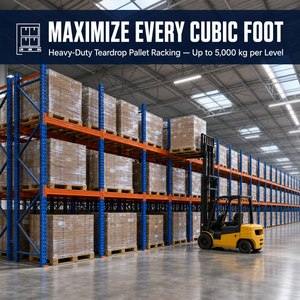
| Selective Pallet Racking | 40% – 50% Floor Utilization | 100% Immediate Selectivity | FMCG, High-Turnover Distribution, High SKU Counts | 1,000 kg – 4,500 kg / Tier | ANSI MH16.1 / FEM 10.2.02 |
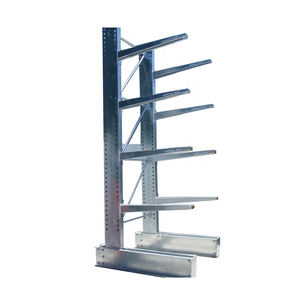
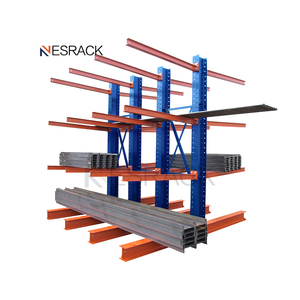
| Structural Cantilever Racks | 55% – 65% Volumetric Density | 100% Side Face Accessibility | Steel Tubing, Timber, Extrusions, Sheet Metal | 500 kg – 2,000 kg / Arm | AISC 360 / AS 4084 |
| High-Density Mobile Racking | 80% – 90% Ultra-High Utilization | 100% Upon Aisle Opening | Cold Storage Freezers, Critical Archives, Low-Rotation Bulks | 8,000 kg – 24,000 kg / Bay | EN 15095 / CE Compliant |
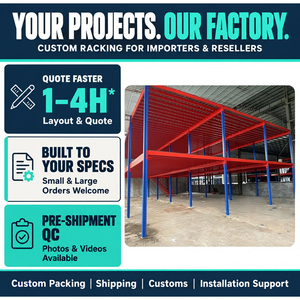
| Structural Steel Mezzanines | 100% Vertical Footprint Doubling | Full Platform Clearance | Pick Modules, E-Commerce Sorting, Light Assembly | 350 kg – 1,200 kg / m² | OSHA 1910 / IBC Table 1607 |
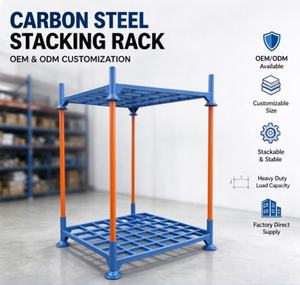
| Modular Stack & Folding Racks | Variable Dynamic Configuration | Bulk Stacked Selectivity | Seasonal Peak Overflow, Agricultural Cold Rooms, Tires | 1,000 kg – 2,500 kg / Unit | ISO 9001 / AWS D1.1 Welded |
Straightforward technical answers to the most critical questions posed by EPC contractors, structural engineers, and global warehouse procurement teams.
To produce an authoritative 2D elevation and 3D parametric proposal, we require: (1) Architectural CAD floor plans indicating column spacing, building expansion joints, and overhead door locations; (2) Clear ceiling height to the lowest building obstruction (fire sprinkler heads, HVAC ducts, lighting); (3) Concrete slab specifications including thickness, compressive strength (f'c rating, typically 25–30 MPa), and rebar depth; (4) Pallet profile: width, depth, overall load height, and gross pallet weight; and (5) Forklift mast specifications including maximum fork height, collapsed mast height, and turning radius (AST).
Our upright frame bracing and beam connector brackets are welded utilizing automated 6-axis robotic welding stations in compliance with AWS D1.1 / D1.1M (Structural Welding Code – Steel). Weld penetration is monitored through periodic destructive macro-etch examinations, ultrasonic testing (UT), and dye-penetrant flaw testing. Welder operators hold certified qualification test records, and production lines are audited against ISO 9001:2015 quality management procedures.
Yes. We execute seismic design calculations in accordance with the International Building Code (IBC 2021/2024), ASCE 7 (Minimum Design Loads and Associated Criteria for Buildings), and Eurocode 8. Based on your site-specific spectral acceleration parameters (Ss and S1 values) and Site Class (A through F), we engineer heavy-duty seismic baseplates, enlarged anchor bolt embedment depths, high-tensile upright frame back-to-back ties, and horizontal top portal bracing to absorb seismic shear forces without structural collapse.
Interlocking box beams are manufactured by cold roll-forming two continuous C-channel sections and mechanically interlocking them along double vertical seams. This geometric construction delivers superior torsional rigidity, resistance to lateral torsional buckling, and eliminates structural weak spots often caused by intermittent stitch welding. The resulting profile provides an exceptionally flat, robust surface for wire mesh decking and heavy pallet supports with uniform deflection profiles.
Standard OEM manufacturing turnaround ranges from 20 to 35 calendar days following shop drawing sign-off and color chip approval. For international export, uprights are packed horizontally with custom protective timber saddles and high-density polystyrene spacers to prevent steel-on-steel friction damage. Beams are stacked in uniform bundle counts tied with steel bands and plastic corner protectors. A standard 40ft High Cube container typically holds between 22 and 26 metric tons of finished racking.
All structural components carry a standard 5-to-10-year manufacturer structural warranty against raw material defects and weld fractures. We supply complete installation manuals, marked 3D assembly shop prints, torque specification charts for all anchor bolts and connectors, and official stamped Safe Working Load (SWL) capacity plaques for mandatory placement on aisle ends per OSHA and European safety standards.
Send your project blueprints, load capacities, and site specifications. Our senior structural design engineers will provide an authoritative feasibility assessment and complimentary 2D/3D layout within 24 hours.