Heavy Industrial Inventory Systems
Engineered Pallet Storage Systems: Certified Export Portfolio
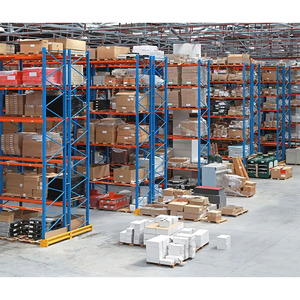
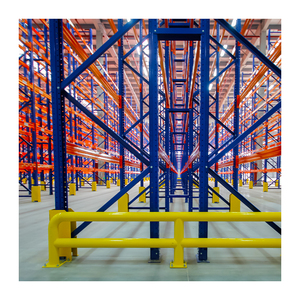
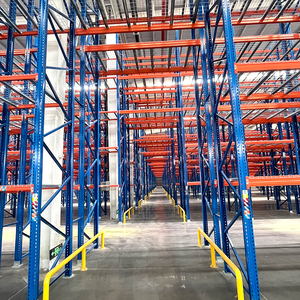
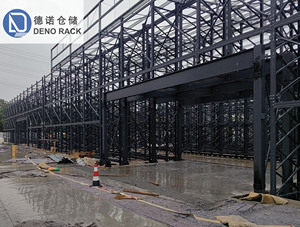
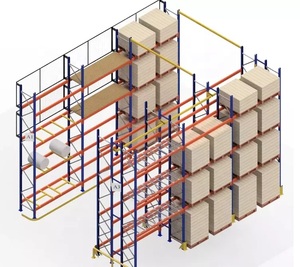
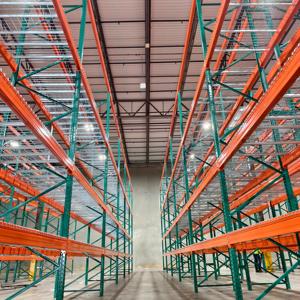
From selective teardrop designs configured to ANSI MH16.1 specifications to robotic multi-tier seismic setups and temperature-controlled cold chain architectures, review our heavy-duty racking solutions designed for maximum spatial optimization and structural reliability.
Material: Q235B / Q355B Steel
Design: Finite Element (FEA)
Pitch: 50mm / 75mm Adjustable
Capacity: Custom Up to 5000kg
Tier Config: 5-Level High Bay
Unit Load: 1000 - 4000 kg/tier
Seismic: Zone 4 Seismic Bracing
Safety: Dual Lock Connectors
Standard: FEM 10.2.02 / CE
Upright Profile: Omega Section Cold Roll
Pallet Type: Euro EPAL 1200x800
Coating: Electrostatic Epoxy
Temperature: Down to -35°C
Anti-Corrosion: Pre-Galv / Special Zinc
Impact Guard: Heavy Upright Protectors
Steel Spec: Impact-Tough Low Temp
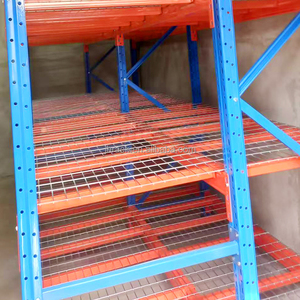
Decking: 50x100mm Wire Mesh
Fire Code: NFPA 13 Compliant Open
Channel: Flanged Waterfall Style
Selectivity: 100% Direct Pallet Access
Australia Spec: AS 4084-2023 Tested
Pallet Dimensions: 1165 x 1165mm AU
Pitch: 76.2mm (3-Inch) Standard
Beam Profile: Roll-Formed Box Beam
US Standard: RMI / ANSI MH16.1
Hole Pattern: Interchangeable Teardrop
Beam Step: 1-5/8 Inch Step Beam
Safety Pin: Auto Spring Plunger Lock
Assembly: Interlocking Fast Assembly
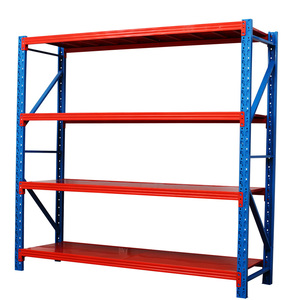
Decking Type: Galvanized Solid Steel
Modularity: Multi-Tier Mezzanine Capable
Finish: Scratch-Resistant Hybrid
Manufacturing Excellence
Precision Steel Metallurgy, Automated Roll-Forming & Global Compliance
As premier Chinese industrial pallet rack manufacturers and international exporters, our infrastructure bridges the gap between cost-efficient high-volume production and stringent Western structural safety codes (RMI, AS4084, FEM 10.2.02, CE).
100%
Structural Testing to Failure (FEM / RMI Guidelines)
Q355B
High-Yield Strength Cold-Rolled Structural Steel
60+
Countries Served with Turnkey Export Logistics
±0.5mm
Automated Continuous Punching Profile Tolerance
High-Grade Metallurgical Traceability
We source prime hot-rolled coils exclusively from premier state-owned mills (Baosteel, Shougang). Every production batch undergoes comprehensive spectrometer analysis and tensile yield testing ($f_y \ge 355\text{ MPa}$), ensuring consistent structural ductility under extreme operational load cycles and seismic stress.
Automated CNC Cold-Roll Profiling
Equipped with 24-station continuous rolling mills and multi-head inline CNC punching presses, our manufacturing lines maintain longitudinal profile tolerances within $\pm 0.5\text{ mm}$. Our proprietary omega upright post geometries optimize the radius-to-thickness ratio, preventing local web buckling.
Certified International Safety Codes
Our structural designs are verified via linear and nonlinear Finite Element Analysis (FEA) against US ANSI MH16.1 (RMI), European EN 15512 / FEM 10.2.02, and Australian AS 4084-2023 standards. Complete engineering calculation packages and seismic certification documents are delivered with every major tender.
Robotic Dual-Torch Beam Welding
Box beams and step beams feature automated continuous seam welding executed by multi-axis Fanuc robotic cells. Full-penetration connector bracket welds eliminate human variance, providing exceptional shear, moment resistance, and cyclic fatigue endurance under frequent counterbalanced forklift operations.
Pre-Treatment & Epoxy Thermosetting
Our automated 7-stage surface preparation incorporates alkaline degreasing, zinc phosphating, and deionized water rinsing prior to electrostatic thermosetting powder application. This achieves a durable 60–80 micron coating thickness capable of exceeding 500 hours of ASTM B117 neutral salt spray testing.
Optimized Ocean Containerization
Shipping steel profiles worldwide demands specialized nestable bundling schemes. Our factory engineering team designs custom wood-chocked steel crates and nesting patterns that maximize 40ft High Cube container cube utilization up to 98%, dramatically reducing per-pallet landed freight expenditures.
System Architecture Selection Matrix
Comparative Engineering Analysis of Warehouse Racking Configurations
Selecting the optimal intralogistics system requires balancing direct selectivity against volumetric cube utilization, forklift travel ergonomics, and total installation expenditure.
| Racking Typology |
Cube Utilization |
Selectivity |
Standard Aisle Width |
Load Capacity / Pallet |
Handling Equipment Type |
Optimal SCM Application |
| Selective Pallet Racking |
40% - 50% |
100% Direct |
3.0m - 3.8m |
500 - 4,000 kg |
Counterbalance, Reach Truck |
High SKU Variety, FMCG, 3PL Distribution |
| Very Narrow Aisle (VNA) |
60% - 70% |
100% Direct |
1.6m - 1.9m |
800 - 2,500 kg |
Wire/Rail Guided VNA Man-up |
High-Bay E-Commerce Hubs, High Land-Cost Zones |
| Drive-In / Drive-Through |
70% - 80% |
20% - 30% (LIFO/FIFO) |
Drive-in Channels |
1,000 - 2,000 kg |
Standard Counterbalance |
Cold Storage, Seasonal Bulk, Uniform Commodities |
| Push-Back Racking |
65% - 75% |
30% - 50% (LIFO) |
2.8m - 3.2m |
800 - 1,500 kg |
Reach Truck, Counterbalance |
2 to 6 Deep Gravity Carts, Buffer Storage |
| Pallet Shuttle (Radio Shuttle) |
80% - 88% |
Channel-Dependent |
Single Main Aisle |
500 - 2,000 kg |
Semi-Automated Mobile Shuttle |
High-Volume Manufacturing, Food & Beverage |
| Automated AS/RS High-Bay |
88% - 95% |
100% Automated |
Crane Rail Dedicated |
Up to 3,500 kg |
Fully Automated Stacker Crane |
Lights-Out Facilities, Pharma, 40m+ Verticals |
Future Procurement Trends in Industrial Storage Infrastructure
1. Decoupled Supply Chains and Strategic Direct-from-Factory Procurement: Global enterprise procurement heads are shifting away from localized distributor middlemen toward direct factory-contracted OEM/ODM manufacturing partnerships in China. By engaging directly with primary manufacturers possessing in-house engineering and finite element simulation capabilities, enterprise buyers eliminate multi-tier distributor markups (often yielding 25% to 40% capital savings on large-scale installations) while securing customized steel sections designed specifically for unique localized building column grids and seismic zone accelerations.
2. Total Lifecycle Costing (TCO) Prioritizing Structural Ductility: Procurement analysis has matured past the simplistic "price-per-ton" benchmark. Sourcing directors now evaluate the 20-year Total Cost of Ownership (TCO), integrating steel corrosion fatigue, accidental upright impact resiliency, floor slab anchor pull-out ratings, and repair turnaround speeds. The integration of high-strength, thin-gauge micro-alloyed structural steels ($f_y \ge 420\text{–}550\text{ MPa}$) allows manufacturers to optimize deadweight while increasing dynamic safety coefficients, resulting in lower shipping freight costs and superior energy dissipation during seismic excitation.
3. Carbon Accounting & Circular Steel Sourcing (Scope 3 Mandates): Multinational logistics operations subject to Corporate Sustainability Due Diligence Directives (CSDDD) and LEED v4 green building accreditations demand comprehensive Environmental Product Declarations (EPD) from Chinese steel exporters. Modern procurement protocols require verification of recycled scrap content, Electric Arc Furnace (EAF) versus Blast Furnace (BF-BOF) emissions data, and non-toxic, volatile-organic-compound-free (Zero-VOC) thermosetting powder finishes that comply with EU RoHS and REACH regulations.
Technological Evolution & Future Development Trends in Racking Systems
1. Deep Integration with Automated Intralogistics & AMR Fleets: The boundary between passive static racking and active automation is disintegrating. Modern high-density storage racks are being engineered as the physical backbone for Autonomous Mobile Robots (AMRs), Automated Guided Vehicles (AGVs), and 4-way multi-directional shuttle systems. This necessitates hyper-precise manufacturing tolerances: beam deflection limits are contracting from standard $L/200$ down to $L/350$ or $L/500$, while post-erection plumbness tolerances are maintained within $\pm 1.5\text{ mm}$ over 30-meter high-bay structures to prevent robotic sensor disruption.
2. Structural Health Monitoring (SHM) via Smart IoT Sensors: The advent of Industry 4.0 has spurred the emergence of sensorized racking columns. Modern export installations in high-volume fulfillment hubs increasingly specify wireless strain-gauge sensors, three-axis impact accelerometers, and acoustic emission detectors integrated directly into rack baseplates and lower upright sections. These edge-computing IoT nodes stream real-time operational data to the warehouse WMS/SCADA platform, flagging structural overloading, micro-buckling, and unnoticed forklift collisions before cataclysmic progressive collapses occur.
3. Advanced Modular Seismic Dissipation & Base Isolation: Conventional rigid anchoring often leads to catastrophic anchor shear and floor slab spalling during significant seismic disturbances. Next-generation seismic-resistant racks designed in China utilize ductile energy-dissipating base connections and friction-pendulum base-isolation dampers. These mechanical joints yield in a controlled, elastoplastic manner under severe horizontal ground acceleration ($S_s \ge 1.5g$), absorbing kinetic energy and safeguarding both multi-million dollar inventory and personnel safety.
Procurement & Technical Intelligence
Frequently Asked Questions: Global Sourcing & Structural Engineering
Critical engineering considerations, testing protocols, and compliance standards addressed by senior structural engineers and global export directors.
How do Chinese steel grades like Q235B and Q355B compare to ASTM and European structural steel standards?
Chinese standard GB/T 700 Q235B possesses a nominal yield strength of 235 MPa and ultimate tensile strength of 370–500 MPa, functioning as a direct engineering equivalent to ASTM A36 and European EN 10025 S235JR. Grade Q355B (GB/T 1591), offering minimum yield strength of 355 MPa, correlates to ASTM A572 Grade 50 and EN 10025 S355JR. For cold-formed racking components, Q355B provides superior strength-to-weight ratios, permitting slender profile geometries while meeting the flexural buckling parameters defined by RMI and FEM 10.2.02.
What floor slab requirements and anchor bolt tolerances are necessary for heavy-duty selective racking?
A typical heavy-duty system with 2,000–3,000 kg pallet loads requires a reinforced concrete slab meeting a minimum compressive strength of 25–30 MPa ($C25/30$), with a thickness generally between 150mm to 250mm depending on point load distribution. For standard selective configurations up to 8 meters, floor flatness classification DIN 18202 Table 3 Group 3 or ASTM E1155 $F_F 25 / F_L 20$ suffices. High-bay VNA systems exceeding 12 meters require specialized Superflat floor specifications (e.g., DIN 15185 or $F_{min} 75\text{–}100$) to prevent dynamic mast sway and catastrophic rack collisions.
How do you protect pallet racks installed in sub-zero (-30°C) cold storage environments from brittle fracture?
At low temperatures, carbon steel undergoes a ductile-to-brittle transition, significantly reducing Charpy V-notch impact toughness and escalating brittle fracture risks under forklift shock loads. For cold storage facilities down to -35°C, we specify killed steels with fine-grained aluminum deoxidation (such as Grade Q355D or Q355E, impact-tested at -20°C and -40°C respectively). Furthermore, components are finished using hot-dip galvanization (ISO 1461) or specialized cold-resistant polyurethane powder coatings that retain flexibility and inhibit micro-cracking at extreme freezing temperatures.
Can teardrop racking manufactured in China seamlessly interlock with existing North American systems?
Yes. Our precision teardrop upright punchings utilize an absolute 2-inch (50.8mm) center-to-center hole pitch with exact 1-5/8 inch step beam brackets matching the universal North American teardrop pattern. This allows 100% interoperability with major US manufacturers' teardrop uprights and beams. All tooling is calibrated via automated coordinate measurement machines (CMM) to ensure spring-loaded auto-locking drop pins engage securely and resist upward dislodgement forces up to 1,000 lbs (4.45 kN) per RMI safety mandates.
What quality control documentation and non-destructive testing (NDT) are supplied prior to overseas shipment?
Every commercial export order includes an Inspection & Test Plan (ITP) dossier containing: raw material Mill Test Certificates (MTC EN 10204 3.1) showing chemical composition and mechanical properties; ultrasonic or magnetic particle testing records for critical beam connector welds; dry-film thickness (DFT) paint reports; cross-hatch adhesion test results (ASTM D3359); and complete factory pre-assembly dimensional verification records validating bolt-hole alignment and beam deflection curves.
How do you configure rack structures for high-risk seismic zones (IBC Seismic Design Category D, E, or F)?
In high seismic zones, structural calculations integrate equivalent lateral force procedures and response-spectrum analysis based on USGS or local spectral acceleration parameters ($S_s, S_1$). We deploy enlarged heavy-gauge baseplates (often 12–16mm thick) with multiple post-installed mechanical wedge or chemical epoxy anchors, heavy-duty tubular horizontal/diagonal upright bracing, external back-to-back row spacers, dynamic spine bracing towers, and reinforced beam-to-column connector brackets with 4-to-5 connector teeth to resist cyclic moment reversals without weld rupture.
Accelerate Your High-Density Intralogistics Project
Submit your architectural CAD layouts or project load specifications. Our engineering team delivers full structural calculations, 3D BIM/Revit models, and turnkey DDP/FOB quotation matrices within 48 hours.