Featured Industrial Cantilever & Pallet Storage Solutions
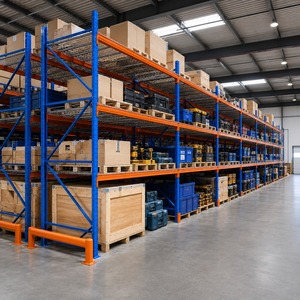
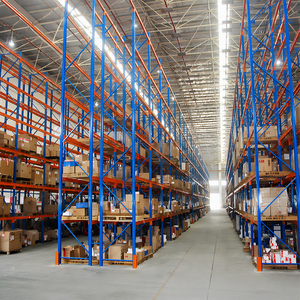
Designed for seamless storage of non-standard long loads, bulky building supplies, heavy steel coils, and automated palletized warehouse hubs. Explore our eight core manufacturing series.
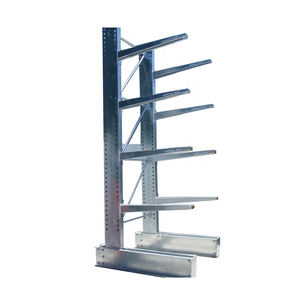
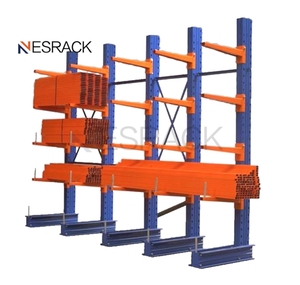
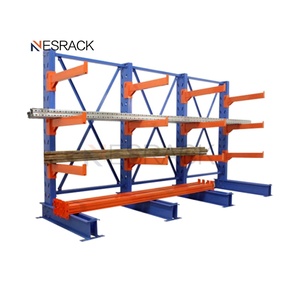
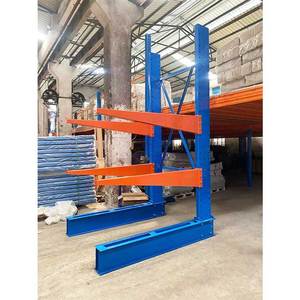
Technical Dissection: Structural vs. Roll-Formed Cantilever Racking
Understanding moment-arm distribution, yield point thresholds, and deflection ratios is crucial when specifying long-load heavy racking systems for high-throughput logistics facilities.
Hot-Rolled Structural Cantilever
Engineered from heavy hot-rolled H-beams and I-beams (ASTM A36 or Q355B structural grade). Designed specifically for punishing industrial settings where heavy impacts from high-capacity counterbalanced forklifts or rough timber handling are common.
- Yield strength: fy ≥ 355 N/mm² for high torsional stiffness
- Solid welded collar connections or high-tensile Grade 8.8 / 10.9 bolted joints
- Superior resilience in sub-zero cold storage and coastal outdoor yards
- Ultimate point-load capacity reaching 1,500 kg to 5,000+ kg per arm
Roll-Formed Light-to-Medium Racking
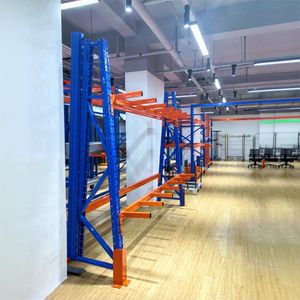
Fabricated through precision continuous multi-station cold roll-forming lines. Provides exceptional cost efficiency and modularity for medium-weight bars, PVC extrusions, light machinery frames, and consumer-goods distribution centers.
- High flexibility with 75mm or 100mm pin-adjustment increments
- Self-locking tapered pin or hairpin safety clip locking mechanism
- Lightweight dead-weight design reducing building slab dead-load stresses
- Fast boltless repositioning without disassembling structural towers
Hot-Dip Galvanizing vs. Electrostatic Coating
Surface finishing determines structural lifespan. We apply automated pre-treatment phosphating combined with thermosetting epoxy polyester powder or high-temperature hot-dip galvanizing according to ISO 1461 standards.
- Hot-dip galvanizing: 85μm - 110μm zinc layer for aggressive outdoor corrosion
- Automated powder line: 70μm - 90μm thickness, salt-spray tested to 500+ hours
- UV-resistant outdoor polyurethane resins preventing chalking and embrittlement
- Impact-resistant polymers resisting chipping from repetitive tines impact
| Engineering Parameter | Light / Medium Duty Roll-Formed | Heavy Duty Structural Cantilever | Extra-Heavy Modular Truss System |
|---|---|---|---|
| Column Section (mm) | 200 × 80 × 2.0–3.0 C-Channel | IPE 240 / HEA 260 / H-Beam 300×300 | Custom Box Column / Welded Truss Girder |
| Arm Length Range (mm) | 500 mm – 1,200 mm | 800 mm – 2,500 mm | Up to 3,000 mm (Support Tray Compatible) |
| Arm Load Rating (UDL) | 150 kg – 800 kg per arm | 800 kg – 5,000 kg per arm | 5,000 kg – 12,000 kg per arm |
| Deflection Limit (FEM / RMI) | L / 180 to L / 200 at full load | L / 250 to L / 300 under dynamic test | L / 350 for robotic automated retrieval |
| Target Cargo Types | Light PVC pipes, carpet rolls, moldings | Steel pipes, timber bundles, steel sheets | Tooling molds, precast slabs, wind turbine parts |
| Aisle Configuration | Wide Aisle / Reach Truck (3.5m - 4.5m) | Side Loader / Four-Way Reach Truck (2.2m - 2.8m) | VNA Guided Rail / AS/RS Crane Corridor |
Future Procurement & Technological Trends in Heavy Storage Systems
Industrial storage is moving rapidly beyond static steel beams. Sourcing managers must evaluate four core industry shifts to safeguard long-term ROI and avoid premature facility obsolescence.
1. Convergence with Autonomous Mobile Robots (AMR) & AS/RS
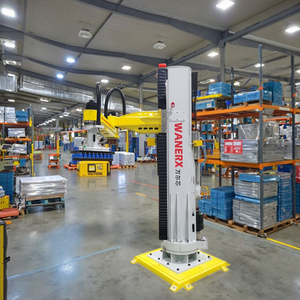
The storage of long goods is shedding manual forklift dependencies. Progressive logistics facilities in North America and Western Europe now demand cantilever designs engineered with laser-aligned guide tracks and optical target reflectors. These accommodate automated guided vehicles (AGVs), automated stacker cranes, and end-of-line robotic palletizers that streamline high-throughput distribution without human intervention.
2. Digital Twin & Finite Element Analysis (FEA) Modeling
Rule-of-thumb engineering has been completely superseded by algorithmic strain simulation. Leading Chinese manufacturers now deliver complete 3D FEA stress charts, finite-element boundary condition reports, and BIM-compatible Revit models. This enables warehouse design teams to detect stress concentrations at column-to-base moment welds before a single ton of steel is processed through fabrication.
3. Low-Carbon "Green Steel" & Life-Cycle Assessment (LCA)
With carbon border adjustments (CBAM) taking hold globally, environmental transparency is no longer optional. International buyers prioritize steel manufacturers employing electric arc furnaces (EAF), zero-VOC heavy-solid powder coatings, and closed-loop acid rinsing lines. Supplying verifiably certified green steel profiles directly lowers Scope 3 emissions for multinational corporate supply chains.
4. Hybrid High-Density Dynamic Storage Configurations
Warehouse floor square-footage costs continue to climb. Rather than dedicating huge footprints solely to cantilever aisles, engineering firms prefer hybrid mezzanine-cantilever superstructures and mobile base-mounted cantilever blocks. Motorized rail carriages allow multiple structural cantilever rows to condense into a single rolling aisle, reclaiming up to 50% of wasted aisle square footage.
5. Seismic Acceleration & Dynamic Ductility Compliance
Earthquake-prone operational regions (e.g., US West Coast, New Zealand, Japan, Chile) require strict validation against international building codes (UBC, IBC, Eurocode 3/8). Sourcing protocols now focus on ductile connection brackets, ground anchor tensile shear resistance, and structural column damping systems that prevent catastrophic progressive collapse during seismic excitation events.
6. End-to-End Containerized Knock-Down Logistics
High ocean shipping tariffs penalize irregular, high-cube structural shapes. Top OEM/ODM facilities design interlocking modular arm bases, stackable welded frames, and custom steel-dunnage packaging systems. These allow 40-foot HQ shipping containers to max out their deadweight (up to 27,000 kg) without leaving expensive empty cubic volume.
Why Global Distributors & EPC Contractors Partner With Our Facility
Combining advanced CNC machining centers, automated Panasonic robotic welding cells, and comprehensive non-destructive load validation for full accountability.
Continuous Roll-Forming & Laser Punching
Our workshops run multi-roll precision rolling lines equipped with in-line servo hydraulic punching. Column pitches are held within ±0.5mm tolerances over 12-meter continuous heights, guaranteeing that cantilever arm pins align without on-site force fitting or hole reaming.
Robotic Arm Welders with Ultrasonic Testing
Crucial moment-bearing joints between cantilever columns and base flanges are welded using Panasonic 6-axis robotic welding workstations. Every critical production batch undergoes ultrasonic flaw detection (UT) and magnetic particle testing (MT) to ensure complete root penetration and zero porosity.
In-House Static & Dynamic Physical Proof Testing
We operate a dedicated 20-meter vertical load test tower. Cantilever arms and selective pallet rack beams are subjected to 1.5× design proof overloads for 72 continuous hours, monitoring creep, residual deflection, and connector deformation against EN 15512 safety protocols.
Comprehensive Export Documentation & Traceability
Every order ships with chemical and mechanical Mill Test Certificates (MTC) matching steel heat numbers to 3.1 certification. Full CE Declarations of Performance (DoP), powder cure cross-hatch adhesion reports, and installation guides are delivered with the bill of lading.
Custom OEM/ODM Engineering & Tailored Accessories
From curved cradle saddles for heavy steel coils, removable retaining end-pins for loose pipe bundles, to solid galvanized steel mesh decks for irregular pallet handling, our engineering department customizes cantilever accessories to exact customer requirements.
Global Logistics & Certified Erection Support
We maintain strategic partnerships with premier ocean carriers to guarantee container space during peak export windows. Optional remote AR-guided site erection supervision or on-site dispatch of experienced bilingual installation managers ensures hassle-free commissioning worldwide.
Step-by-Step Engineering Procurement Process
From raw warehouse dimension verification to final container offloading, we execute a rigorous, transparent workflow that mitigates project risk.
Load Profiling & CAD Layout
Submit your cargo specs: bundle length, outer diameter, unit weight, maximum deflection tolerance, forklift model, and clear floor heights. We produce optimized DWG floorplans within 24 hours.
Structural FEA & Static Calculations
Our structural engineers execute load simulations verifying column overturning moments, arm deflection (L/200), and anchor bolt shear stresses based on local building seismic acceleration coefficients.
Raw Steel Sourcing & CNC Fabrication
Certified prime Q235B/Q355B coils and structural H-beams enter production. High-speed CNC saws, robotic welding stations, and roll-formers complete parts under strict ISO 9001 internal checkpoints.
Finishing, Dunnage & Containerization
Components receive powder coating or hot-dip galvanizing, followed by salt-spray testing. Racks are strapped to steel skids, wrapped with protective film, and loaded into 40ft containers with weight-optimized distribution.
Frequently Asked Questions (Procurement FAQ)
Detailed answers to critical technical questions asked by structural engineers, procurement executives, and safety managers when importing cantilever systems from China.
What calculations determine whether I need structural H-beam or roll-formed cantilever racks?
+
How do you calculate arm deflection and load capacity under EN 15512 and RMI standards?
+
Can cantilever racking be customized to support pallets alongside long loose goods?
+
What concrete slab thickness and concrete compressive strength are required?
+
How do you guarantee corrosion protection for outdoor or coastal shipyard installations?
+
What quality assurance documentation is provided prior to container loading?
+
Accelerate Your Facility's Material Handling Efficiency
Connect directly with our senior racking structural engineering team. Receive detailed DWG layouts, FEA stress analyses, and direct manufacturer pricing within 24 business hours.
Send an Inquiry